
Notes from
the ground.
World Space Week runs 4-10 October, and the 2026 theme is Rocket Revolution. Our contribution is two short notes on what the theme means on the ground: what reuse does to re-entry, and what a lander meets at touchdown.
Re-entry is
now a cycle.
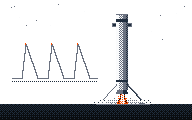
The revolution in rockets is reuse. A vehicle that flies again turns re-entry from a single event into a thermal cycle.
Reusable launch and re-entry vehicles see surface temperatures swing from cryogenic soak to over 1000 °C aero-heating on every flight, then back within minutes. A thermal protection layer has to hold dimensional and structural integrity through hundreds of these cycles without delamination or microcrack growth.
Space hardware is specified against a thermal cycle, not a temperature. What fails is alignment, flatness or bond integrity, not the material itself.
Strocera's adaptive glass-ceramic is supplied as a ready-to-fire powder blend with thermal expansion adjustable from negative to near-zero across 100 to 800 °C, so a thermal protection layer can be matched to the structure it bonds to.
Landings end
on regolith.
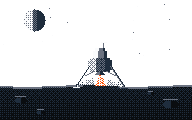
Every rocket that lands on the Moon finishes its flight on regolith. Touchdown is a single event with no second attempt.
The landing gear meets the surface at descent velocity, the footpads penetrate, and the vehicle either settles inside its tip-over margin or it does not. What governs that outcome is the bearing behaviour of the soil under a short, high load.
Descent engine plume erosion changes the surface before the footpads reach it, so the bed a lander is qualified against has to represent disturbed regolith as well as undisturbed. Generic sand carries load differently from regolith at every one of those points.
Regolithia is Strocera's Apollo-traceable lunar regolith simulant, in Highland and Mare variants at phase match 96.4 % and 99.2 % against their Apollo reference soils. The particle size distribution is published on each datasheet, so a test bed can be prepared to a stated condition and reproduced across campaigns.
4-10 October,
every year.
World Space Week was declared by the United Nations General Assembly in 1999. It marks two dates: the launch of Sputnik 1 on 4 October 1957 and the entry into force of the Outer Space Treaty on 10 October 1967. Events, the annual theme and the global calendar are at worldspaceweek.org.
Strocera is not affiliated with the World Space Week Association. These notes are published independently for World Space Week 2026.
Also this
month.
Strocera is at Tech Week in San Francisco (5-11 October) and Los Angeles (12-18 October).