A ceramic powder mix formulated to your application's thermal expansion, not the other way around.
Mean (secant) CTE by push-rod dilatometry on a sintered specimen; instantaneous coefficients vary across the range. AGC-01 is a development material: data from laboratory batches, not yet a qualified specification.
| Tier | Container | GrossNominal | DimensionsNominal |
|---|---|---|---|
| 1 kg | 1.5 L wide-neck HDPE jar, pigmented | 1.5 kg | 16 x 16 x 20 cm |
| 5 kg | 6 L HDPE pail, pigmented | 6.2 kg | 28 x 28 x 32 cm |
| 25 kg | 5 x 5 kg HDPE pails, pigmented | 30 kg | 60 x 30 x 34 cm |
Moisture sensitive. Keep the barrier bag sealed until use.
Every product ships with its characterization report, referenced to the specification it was built against. Where a value is not measured, it is not published.
Where a published grade does not fit the requirement, a paid evaluation puts your specification through the same measurement stack.
Request a paid evaluationThe unmodified blend contracts continuously over 100 to 800 °C: mean CTE approx. -5.8 × 10⁻⁶ /K from 25 to 780 °C. The negative expansion of the blend offsets the positive expansion of alumina, so the net coefficient of the fired body is set by the proportion in which the two are combined, from the continuous negative behaviour of the unmodified blend up to near-zero net expansion. You state the expansion behaviour the design requires; targets are agreed and verified by dilatometry on a trial specimen before series supply.
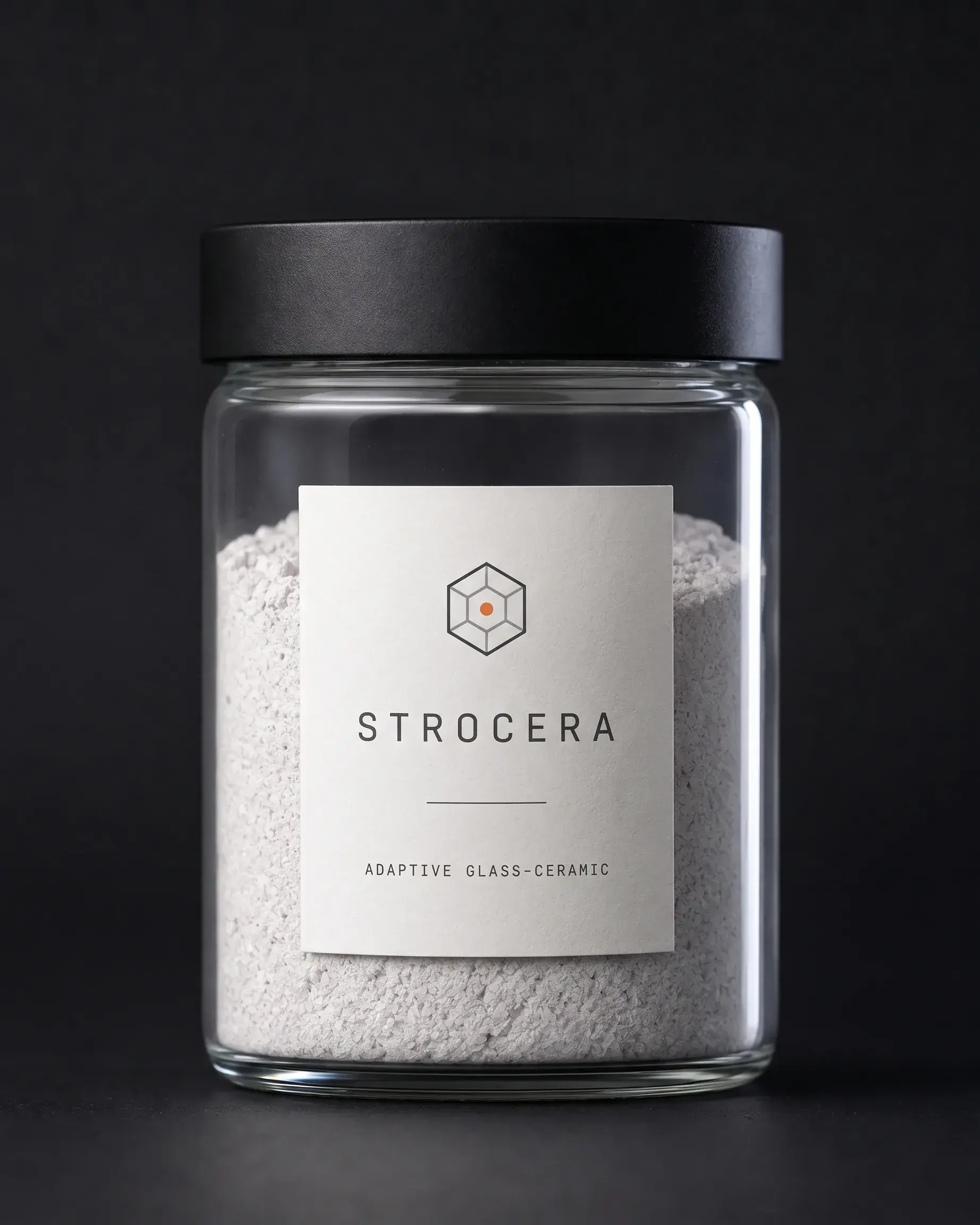
Dry, ready-to-fire powder blend, formulated from high-purity α-alumina and a proprietary boron-based additive. You shape and fire it in your own facility; the firing schedule is issued per project. Alternatively, combine the standard blend with your own alumina in-house and set the net coefficient at the point of use.
Survives repeated 800 °C to 20 °C water quench. Specimens heated to 800 °C and above and quenched abruptly into water at 20 °C, repeated on the same specimen, retain their structural integrity and remain serviceable. Video-documented. A quantified protocol to ASTM C1525 is in preparation.
Quantities are quoted directly and formulation runs through engineering.